

The Best Lens for Photographing the Palio di Siena
The Best Lens for Photographing the Palio di Siena
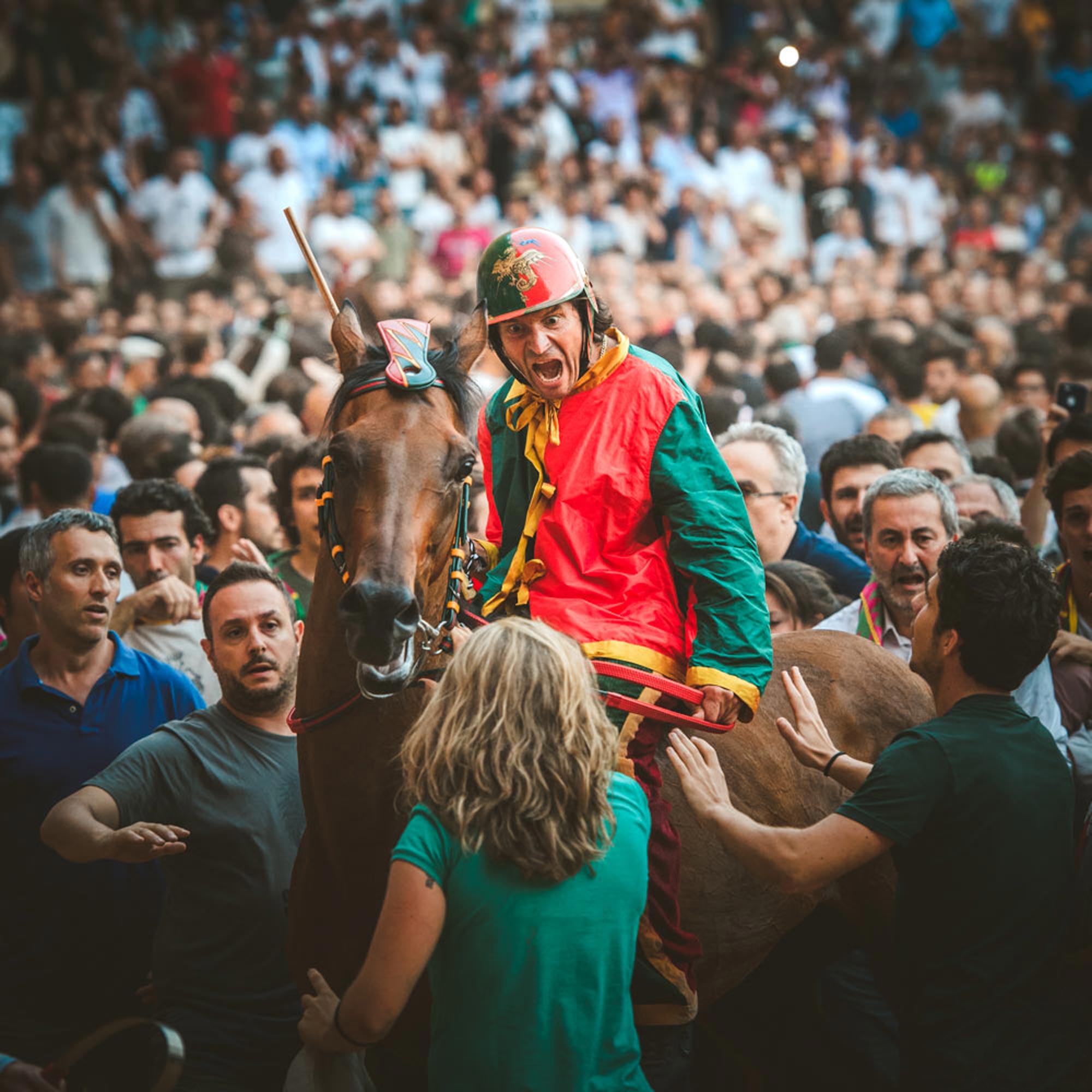
Photographing the Palio di Siena is not the kind of assignment where I would choose a lens simply because it produces the most beautiful image. The race takes place in an extremely demanding environment. You are standing on the tufo, surrounded by a huge crowd and dozens of other photographers, with very little room to move and absolutely no control over what is going to happen next. The light is also changing rapidly because the race takes place late in the afternoon.
For me, the best lens for the Palio is therefore not necessarily the most versatile or the most artistic one. It is the lens that allows me to remain fast, light and responsive when everything around me is changing.
The Tufo Demands a Different Kind of Equipment
When you photograph the race from inside Piazza del Campo, every unnecessary piece of equipment becomes a disadvantage. On the tufo, I want to be as light and agile as possible. There is a large crowd, very little space and constant movement. You may need to change your position quickly, react to something happening behind you or suddenly adjust your framing.
This is not the moment to carry several heavy lenses simply because they might be useful. That is why I make a very clear distinction between the race and the morning trials. During the Prove, there is much more freedom to experiment. You can work with different focal lengths, slower lenses or even fixed focal lengths when the purpose is to create a particular type of image.
The race is different. Here, I would leave all of that aside and concentrate on one thing: having an optic that allows me to work quickly and reliably in difficult light.
At the Palio, f/2.8 Is the Starting Point
The race takes place in the late afternoon and the light can change considerably while you are waiting for the Mossa. For this reason, I consider f/2.8 the minimum aperture for the main lens I use during the race.
I would not sacrifice luminosity simply to gain more focal length or a more compact lens. At this time of day, the extra light provided by a fast lens is much more useful than an extended zoom range.
The priority is to maintain a shutter speed fast enough to freeze the movement of the horses and jockeys as the available light decreases. I would rather accept a higher ISO than compromise the shutter speed and risk losing the decisive moment.
This is also why I would not choose a fixed focal length as my primary lens for the race.
A fast prime can produce beautiful, highly characterful images and can be an excellent choice in a controlled situation. But the Palio is reportage. The distance between you and the action is constantly changing and you cannot predict exactly where the decisive moment will happen.
A fixed lens may give you a more distinctive image.
A zoom gives you more possibilities.
For the race, I choose the latter.
Why the 70–200mm Works So Well at the Mossa
My preferred lens for photographing the race is the 70–200mm f/2.8.
It is not perfect. In fact, it has one very obvious limitation: it does not allow me to include the entire context whenever I want.
From the Mossa, for example, I cannot photograph the complete line of horses at once. At 200mm I am working with a substantial portion of the scene rather than the entire row.
But this is a compromise I am happy to make.
The 70–200mm gives me the flexibility to move from a wider view of the action to a much tighter image of a horse and jockey without changing lenses. From the Mossa, that flexibility is extremely valuable.
There is another reason why I do not necessarily want to go wider. The exposure difference between the area around the canape and the background can be considerable. Behind the horses, the Palazzo Pubblico is often much brighter than the area of the track where the action is taking place.
With a very wide lens, I may end up including both areas in the same frame. The resulting difference in exposure can become difficult to manage, particularly as the light changes.
A slightly longer focal length allows me to control the frame more precisely and concentrate on the part of the scene where the action is actually happening.
For me, this is more important than being able to show every horse in the same photograph.
Reading the Light in Piazza del Campo
The choice of lens cannot be separated from the way light moves through Piazza del Campo. The conditions are radically different depending on the time of day. The position of the sun changes continuously and the Torre del Mangia almost works like a giant sundial, progressively changing the areas of direct light and shadow across the Piazza.
This becomes particularly important when deciding whether a wider lens will actually help. A wide-angle can produce spectacular images when the exposure across the scene is relatively consistent. But when you have a subject in a darker area and a much brighter building or sky within the same frame, the difference in exposure can be substantial.
In those situations, getting more of the Piazza into the photograph does not necessarily mean creating a better photograph. This is why I do not believe there is one universally perfect lens for photographing the Palio.
There is, however, a lens that makes more sense for a specific moment. For the race, from the Mossa, my choice is the 70–200mm f/2.8. It keeps me relatively light, gives me enough reach, allows me to react quickly and provides the luminosity I need as the afternoon light disappears.
The lens itself does not make the photograph. But when you have one chance, surrounded by a crowd, on the tufo, with the light changing by the minute, choosing the right tool can give you the freedom to concentrate on the only thing that really matters: being ready when the Palio happens.
“`
