

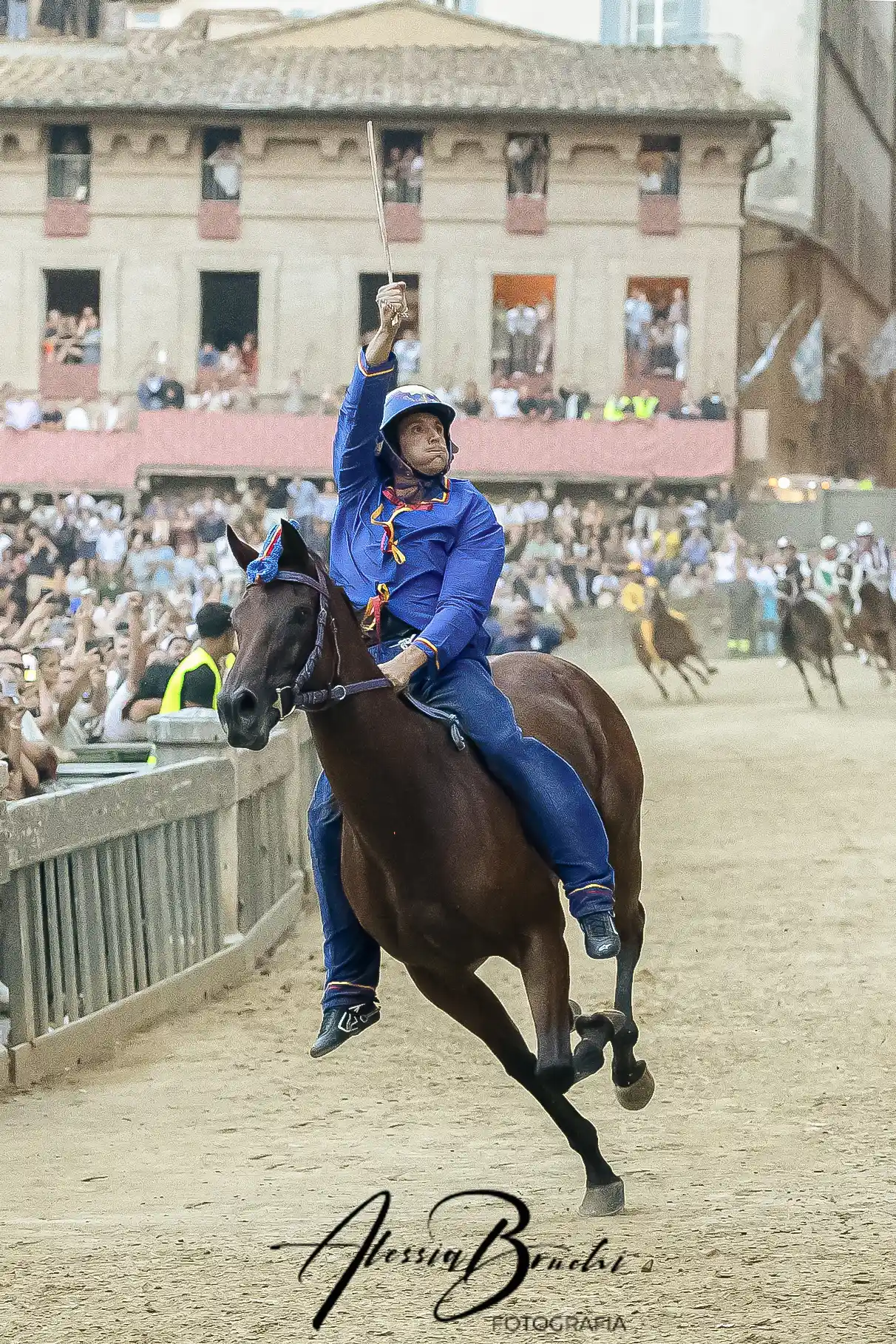
The Nicchio’s winning finish
As every year, my position for the Palio is the Mossa.
The August 2026 Palio was particularly challenging from a photographic point of view. The winning Contrada was Nicchio, with Giovanni Atzeni, known as Tittia, riding Anda e Bola — a name meaning “go and fly” in Sardinian, and perhaps nothing could have been more fitting for a horse that virtually every Contrada would have wanted in their stable.
The Mossa took a long time and by the time the race finally started, the light had already dropped considerably. I photographed the entire race with my 70–200mm f/2.8, working mainly at the longer end of the zoom. Shooting with a 70–200mm from the Mossa is not particularly easy. You are surrounded by photographers, the space to move is limited and you need to follow the action while constantly being aware of what is happening around you. At 200mm, there is also the very practical problem of trying to follow the race without accidentally hitting one of your colleagues in the head. 😅
The Technical Challenge of Photographing the Finish
When Nicchio won the Palio di Siena, the situation became even more complicated. As soon as the winning horse crossed the finish line, a huge number of people flooded onto the track. The available shooting angles changed within seconds and keeping a clear line of sight to Tittia and Anda e Bola became extremely difficult. There was very little margin for error. A fraction of a second was enough for another person to enter the frame, another photographer to block the subject or the horse and jockey to disappear completely behind the crowd.
At the same time, I had to keep moving and repositioning while continuing to photograph. You cannot simply stop, wait for the crowd to clear and try again. The decisive moment is happening in front of you and you have to keep working through the constantly changing gaps. For the finish, I was shooting at 1/800 sec, f/3.5 and ISO 12,800. At ISO 12,800 the file obviously contains some noise, but with the Nikon D5 it remains perfectly usable for this kind of work. In these conditions, keeping the shutter speed high enough to freeze the action was far more important than trying to keep the ISO low.
I would rather have a slightly noisier file than a blurred or missed photograph. At the Mossa, there is no second chance. The sun had completely disappeared by then and the light had moved into that characteristic blue twilight. I deliberately warmed the white balance slightly in post-production because the D5 tends to interpret this particular transition much cooler than I perceive it with my eyes.
From the Mossa to San Martino
Photographing the Palio is not only about getting the race from your assigned position. Once the finish has happened, you immediately have to start thinking about what might happen next. After the finish, the influx of people in Piazza del Campo was so large that I decided to leave the Mossa and head towards the San Martino curve, hoping to get onto the stage. My idea was to try to recreate something similar to the image I had managed to photograph in July after the Aquila victory.
In July, from the stage, I had photographed a spectacular yellow river of Contradaioli, with the Palio and Giovanni Atzeni, Tittia, lifted above the crowd. It was a completely different perspective from the Mossa and one that allowed me to photograph the celebration from above, with the crowd filling the Piazza beneath the Palio. It was exactly the kind of situation worth trying to anticipate again in August. This time, however, things developed differently. Shortly after the finish, Giovanni Atzeni fell, changing the dynamics of the celebration completely. The image I had hoped to recreate — Tittia and the Palio being carried above the crowd — was therefore not possible. From the stage, I was instead able to photograph the Palio emerging from Piazza del Campo, without Giovanni above the shoulders of the Contradaioli.
Working at 1/200 sec in the twilight
By this point, the light was even lower and the scene was well into twilight. However, shooting from the stage gave me a completely different technical advantage. I was stationary and no longer needed to track a horse running at full speed, so I could safely lower the shutter speed. I worked at around 1/200 sec, gaining two stops of light compared with the 1/800 sec I had needed during the race.
That difference is significant when you are already working in very low light. The camera can gather considerably more light without having to push the ISO even further, while 1/200 sec is still fast enough to manage the movement of the crowd and the Palio. This is also why the position you choose after the finish matters so much. The same Piazza can require completely different camera settings depending on whether you are tracking the race from the Mossa or photographing the celebrations from a fixed position on the stage.
The experience behind the photograph
Reading the Palio, not just photographing it
This is one of the things that continues to fascinate me about being a Palio di Siena photographer. The technical settings are only one part of the job. You need to know the geography of Piazza del Campo, understand how the race develops, anticipate what might happen after the finish and constantly judge whether your position is still the right one.
The conditions can change in seconds.
The Mossa can take longer than expected and the light can disappear while you are waiting. The winning Contrada can bring an enormous crowd onto the track. A jockey can fall. The celebration can take an entirely different direction from what you imagined. You have to react to all of it while continuing to photograph.
After years of photographing the Palio di Siena, I have learned that knowing your equipment is only one part of the job. Knowing when to change position, when to lower the shutter speed, when to accept a higher ISO and when to move quickly towards another part of Piazza can make just as much difference.
When the photograph is waiting somewhere else
Sometimes, the photograph you are waiting for is already there, right from your position. That is what happened in August. Despite the fading light, the chaos and the crowd flooding the track, I knew I had captured something special. Everything came together in a fraction of a second. In July, it was different. I realised almost immediately that the finish from the Mossa was not giving me the image I wanted. So I left and ran towards San Martino — and found the photograph I was looking for.
That is the Palio: sometimes the photograph finds you. And sometimes, you have to go and find it.
